New England Fans Won’t Like What Alexa Thinks Of The Patriots

Seems like everyone has an opinion about Sunday’s Super Bowl ― even Alexa, the human-like bot on the Amazon Echo device.

People who’ve asked the device who is going to win have been surprised by the rather heated response:

“The team favorite to win is the, cough, the, cough, excuse me, is the Patriots. That was tough to get out,” the device says. “But I’m flying with the Eagles on this one because of their relentless defense and the momentum they’ve been riding on their underdog status. E-A-G-L-E-S ― EAGLES!”


New Yorker Amber Jacquot discovered that Alexa is an Eagles fan Tuesday night, asking the bot numerous times before filming the video above.

HuffPost employees with the Amazon Echo confirm they’ve heard similar responses as well.

An Amazon rep told HuffPost that Alexa often roots for the underdog.

“She had a friendly rivalry with the Patriots last year, and that sentiment continues this year,” the spokesperson told HuffPost by email.

Meanwhile, other digital assistants aren’t nearly as passionate or anti-Pats.

The Google Assistant says, “I’m still deciding who to root for,” when pressed for an answer.

Apple’s Siri just goes with the current point spread: 

“Apparently the odds favorite the Patriots over the Eagles by 4 1/2 points,” it says. 

UPDATE: This story has been updated to include Amazon’s response.

Second Person Of Interest Related To Las Vegas Massacre Admits Selling Gunman Ammo

A second person of interest related to last year’s mass shooting at a Las Vegas music festival was identified as an ammunition dealer who sold to gunman Stephen Paddock, according to newly unsealed court documents.

The dealer, Douglas Haig, was named alongside Paddock’s wife, Marilou Danley, as a possible conspirer in the October massacre that left 58 people dead and hundreds more injured, The Las Vegas Review-Journal reported. Haig, who is also an engineer, admitted to selling the ammunition, but denied knowing who Paddock was or that he planned anything nefarious.

The documents, unsealed by a judge on Tuesday, were prepared by the Las Vegas Metropolitan Police Department in October. They state that both Haig and Danley remain persons of interest “until the investigation can rule otherwise.”


It’s not clear whether Haig remains under investigation. Danley, who was in the Philippines at the time of the attack, is not expected to be charged, Clark County Sheriff Joe Lombardo said this month.

According to CBS News, authorities contacted Haig after investigators found an Amazon box in Paddock’s Las Vegas hotel room that had Haig’s address on it.

Haig has told media that he met with Paddock a few weeks before the shooting but that it was only to sell him ammo ― 720 rounds of tracer ammunition, to be exact.

“I couldn’t detect anything wrong with this guy,” Haig told CBS News. “He told me exactly what he wanted, I handed him a box with the ammunition in it, he paid me and he left.”


Haig said Paddock, who authorities said died of an apparent self-inflicted wound after the shooting, told him that he planned to put on a “light show” with the tracer ammunition, which leaves behind a visible trail when fired.

Records show that Haig owns the store, Specialized Military Ammunition LLC, The Associated Press reported. The store’s website, which lists it as closed “indefinitely,” boasts a variety of projectiles.

Haig’s LinkedIn profile also lists him as a senior engineer for Honeywell Aerospace in Arizona. The company confirmed his position there to the Review-Journal. 

Haig, speaking to reporters on Tuesday outside his Mesa, Arizona, home, said he planned to hold a press conference on Friday.


This isn’t the first time that Haig has denied having known Paddock.

In October, he gave an interview with Newsweek, during which he said federal agents from the Bureau of Alcohol, Tobacco, Firearms and Explosives interviewed him shortly after the Oct. 1 shooting. That interview was published on Tuesday for the first time.

“After about 20 minutes they left. Haven’t heard from them since,” he said. “I have to think that if it was really, really serious or there was something that they thought I did that was wrong, (the agents) would have been kicking my door down.”

PS4 Vs PS4 Slim Vs PS4 Pro: What Are The Differences And Which PlayStation 4 Should You Buy?

With three major PS4 models out on the market, it’s easy to be a little confused as to the different specs and features of each SKU. We’re going to clear that situation up in this article and break down which PS4 is right for you. You can also check out our review of the original PS4, review of the PS4 Slim, and review of the PS4 Pro. To see how all the modern consoles, including all SKUs of PlayStation 4 compare, click here.

PS4 Specs

PlayStation 4

PlayStation 4 Slim

PlayStation 4 Pro

CPU

1.6GHz 8-core AMD custom “Jaguar” CPU

1.6GHz 8-core AMD custom “Jaguar” CPU

2.1GHz 8-core AMD custom “Jaguar” CPU

GPU

Integrated AMD graphics clocked at 800MHz with 1.84 teraflops of performance

Integrated AMD graphics clocked at 800MHz with 1.84 teraflops of performance

Integrated AMD Polaris graphics with 4.2 teraflops of performance

RAM

8GB GDDR5

8GB GDDR5

8GB GDDR5 + 1GB DDR3

Storage

500GB (5,400rpm) replacable hard drive.

500GB (5,400rpm) replacable hard drive.

1TB replacable hard drive.

Dimensions

12. x 10.8x 2 inches

11 x 10 x 1.5 inches

12.8 x 11.6 x 2.1 inches

Weight

6.2 pounds

4.6 pounds

7.2 pounds

Color

Black or white

Black

Black or white

Optical Drive

Blu-ray/DVD

Blu-ray/DVD

Blu-ray/DVD

Networking

Gigabit Ethernet, 802.11 B/G/N, 2.4GHz, Bluetooth 2.1

Gigabit Ethernet, 802.11 B/G/N/AC, 2.4GHz, 5GHz, Bluetooth 4.0

Gigabit Ethernet

802.11A/B/G/N/AC, 2.4GHz, 5GHz, Wi-Fi, Bluetooth 4.0

Internet Subscription

PS Plus required to play online

PS Plus required to play online

PS Plus required to play online

Ports

HDMI, analog-AV out, 2xUSB 3.0, AUX, S/PDIF

HDMI, analog-AV out, 2xUSB 3.1, AUX

HDMI, 3x USB 3.1, 1x Gigabit Ethernet, 1x PS Camera, S/PDIF, AUX

4K Support

Yes (video only)

Yes (video only)

Yes

HDR Support

Yes

Yes

Yes

Release Date

November 15, 2013

September 15, 2016

November 10, 2016

Release Price

$399.99,€399.99, £349.99

$299.99, €349.99/£299.99

$399.99, €399 / £349

Current Price

$299.99, €349.99/£299.99

$299.99, €349.99/£299.99

$399.99, €399 / £349

What are the differences between the PS4 and PS4 Slim?

The PlayStation 4 Slim, released September 2016, replaces the base PS4 and its underlying specs are largely the same as the original 2013 model. This means you won’t see improved graphical fidelity or performance, but there are several small differences. The most noticeable one is that the PS4 Slim is, well, slimmer. Its 11x10x1.5-inch chassis is smaller in every dimension compared to the original’s 12x10x8.2 inch case. It’s also 1.6 pounds lighter, weighing 4.6 pounds in total.

Unlike the original PS4, the Slim gets rid of the half-gloss finish and opts for a completely matte black look. The Slim also has rounded corners as opposed to the original model’s more edgy design.

There are some under-the-hood improvements as well. The Slim now supports 5GHz Wifi, which is generally faster than the 2.4GHz wireless band of the original console, provided you have a router that can take advantage of it. The Slim also supports Bluetooth 4.0, which is more power-efficient and offers better wireless audio performance. Another new addition that the Slim features is USB 3.1 support, which is up to two times as fast as the original’s 3.0 ports.

No Caption Provided

The PS4 Slim is also a little more power-efficient overall. Whereas the original PS4 is rated to consume 250-watts, the Slim features a 165-watt thermal design power. Its more power-efficient design allows it to run a bit cooler and quieter, too.

If the Slim does have one drawback over the original, it’s the removal of the SPDIF port, which will impact soundbars that require an optical connection.

Should you upgrade to a PS4 Slim if you have a PS4?

The Slim doesn’t make a ton of improvements over the original PS4. If you already own a perfectly functional PS4, it doesn’t make much sense to get the Slim. Furthermore, if you want a more powerful PlayStation, the PlayStation 4 Pro is what you want.

PS4/PS4 Slim vs PS4 Pro

While the PS4 Slim isn’t much of a technical leap from the base model, the 2016-released PS4 Pro represents a mid-generational upgrade that offers a significant boost in processing power. Sony designed it to take advantage of the burgeoning 4K TV market.

Because 4K is four times the resolution of 1080p and is much more graphically demanding, the PS4 Pro has many under-the-hood improvements. It features a 4.2 teraflop GPU clocked at 911MHz based on AMD’s Polaris micro-architecture. This is 2.2x as much as the PS4/PS4 Slim. While it still features an 8-core custom Jaguar CPU from AMD, it runs at a higher 2.1GHz frequency, which is 500MHz faster than the PS4/PS4 Slim. In terms of RAM, the PS4 Pro still uses 8GB of GDDR5 memory, but also adds 1GB of conventional DDR3 RAM to bolster 4K video streaming applications.

No Caption Provided

The PS4 Pro also uses a SATA III-based storage interface, as opposed to the SATA II-based solution of the original model. This means if you install an SSD in the PS4 Pro, it can be dramatically faster and reach theoretical speeds of six Gbps. While the PS4 Pro comes with a hard drive, its one TB allotment is twice as capacious as the PS4’s HDD before it.

In terms of design, it’s significantly bigger and heavier than the base model with its 11x10x1.5 inch dimensions and 7.2-pound weight. Aesthetically, it maintains the slanted design of the original PS4 but opts to use the rounded corners that debuted on the PS4 Slim. There’s also a new power LED light bar at the front. Unlike the Slim model, it boasts the SPDIF port so you can use it with soundbars that require an optical connection. Finally, it features three USB 3.1 ports, which is one more than the PS4 Slim before it.

What are some of the PS4 Pro’s advantages?

While the PS4 Pro currently retails for $100, €50, £50 more than the PS4 Slim, its more powerful hardware allows it to run certain games at 4K or at higher-than-1080p resolutions. Some games may also receive frame rate improvements or could feature higher graphical fidelity visuals.

While its benefits are most evident when coupled with a 4K TV, it is capable of supersampling certain games on 1080p displays. Supersampling is an effective form of anti-aliasing that removes undesirable jaggy edges from games.

Which PS4s support HDR?

With a September 2016 firmware update, all PS4 SKUs support HDR. This includes the original model, the Slim, and the Pro.

Are there any user interface differences between the PS4 and PS4 Pro?

The PS4, PS4 Slim, and PS4 Pro use the same operating system and UI.

Which PS4 should you get?

If you don’t already have a PS4 and have a 1080p TV and just want an affordable option to play PS4 games, the PS4 Slim is a sensible choice. We wouldn’t suggest upgrading to a PS4 Slim if you already have a PS4, however, considering you won’t get a performance boost. If you have a 4K TV, however, or are interested in getting one in the near future and have the extra cash to spare, the PS4 Pro is a better investment, with its superior, more future-proof hardware that can make games run and look better. Should you upgrade to a PS4 Pro if you already have a PS4? We would generally only recommend upgrading if you have a 4K TV and the cash to spare.

Paul Ryan’s Slip About ‘Preventing’ Trump Was Best Part Of The SOTU

Tell us how you really feel!

Donald Trump’s supporters may have enjoyed the president’s first State of the Union address, but the highlight for many people was the way House Speaker Paul Ryan (R-Wis.) introduced it.

“I have the high privilege and the distinct honor of preventing, uh, presenting to you the president of the United States,” Ryan said.

Here’s a clip from C-SPAN.

Whether it was a just a verbal slip of the tongue or an inadvertent expression of Ryan’s true feelings may never be known ― it’s not like Ryan would admit it.

Still, the gaffe provided amusement to many people on Twitter ― and that’s what really matters, right?

Of course, a lot of people drew on the lessons learned from their Intro to Psychology class.

Others suspected Ryan’s intro was really a cry for help.

Others let GIFs express how they felt.

One man lamented the decline of verbal facility in politicians.

But Ryan was no one-trick pony when it came to meme-able moments, as his reaction when Trump said “In God We Trust” amply demonstrates.

As you might expect, the action inspired many comments on Twitter.

Although many people seemed to enjoy making fun of Ryan, one man had a simple solution to help the speaker prevent himself from becoming a meme in the future.

As Disney-LA Times Spat Resolved, Paper’s Prez Never Revealed She Lived With Disney VP

Last September, the Los Angeles Times published a blockbuster report detailing Disney’s questionable business ties with the city of Anaheim. In response, Disney barred Times writers from advance screenings of its movies and, according to a former Times employee, froze them out of interview availabilities. When Disney finally ended its blockade on Nov. 7, the company said in a statement that it “had productive discussions with the newly installed leadership at the Los Angeles Times regarding our specific concerns, and as a result, we’ve agreed to restore access to advance screenings for their film critics.”

From those facts alone, it might have seemed as if the Times had won. The Mouse had blinked first, and honest journalism had carried the day.

In a recording of a meeting obtained by The New York Times, however, the then-newly installed and now former editor-in-chief Lewis D’Vorkin can be heard shooting down suggestions that the paper re-promote its original investigative report. Staffers were even warned “against retweeting any praise” of LA Times stories, according to The New York Times. Some employees, The New York Times said, “questioned whether the social media edict was part of a deal Mr. D’Vorkin had struck with Disney.”

D’Vorkin, now chief content officer for Tronc, corporate parent of the LA Times, denied any such arrangement to The New York Times.

But it turns out the Mouse and the LA Times really did have an undisclosed connection after all.

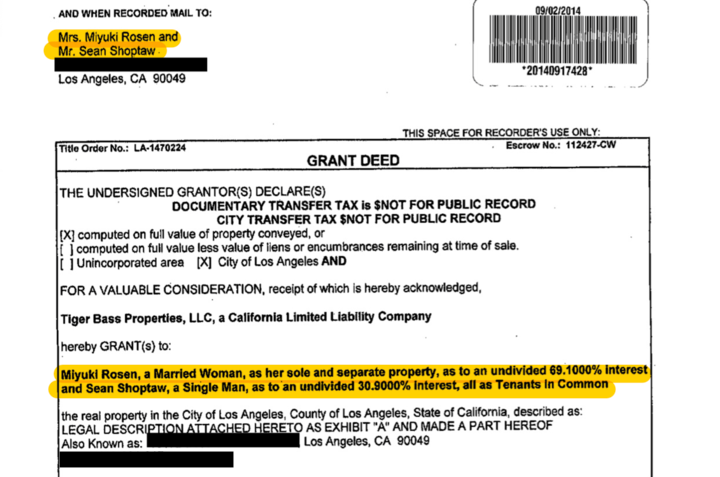
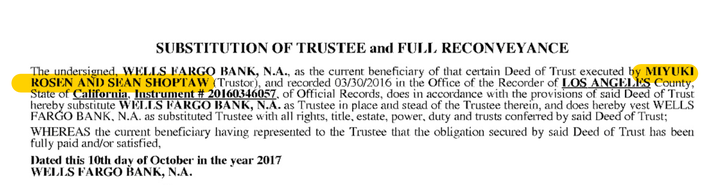
According to real estate documents filed with Los Angeles County, then-LA Times president Miyuki “Mickie” Rosen had been sharing an address in Brentwood with Sean Shoptaw, a Disney vice president for business development, since at least 2014. That year Rosen filed to give Shoptaw ownership of a third of the property where she had previously lived with her husband.


Public filings show that Rosen and Shoptaw still shared ownership of the address as recently as this past October.


Rosen had been announced in her new role as LA Times president a month prior to Disney’s decision to end the blockade against the paper. The fact that she apparently owned a home with a Disney vice president was never disclosed publicly nor was it revealed to the staff. Multiple current and former LA Times employees with varying degrees of seniority told HuffPost that they had never heard anything about Rosen’s connection to the Disney vice president.

This raises the question of how much of a role Rosen played in what Disney referred to as “productive discussions with the newly installed leadership.” Based on his LinkedIn profile, Shoptaw appears to work with consumer products, meaning that he likely wouldn’t have had an active role in any negotiations with the paper.

Rosen was brought on at the same time as D’Vorkin, two months after Ross Levinsohn came aboard as publisher and chief executive officer. Levinsohn is now on leave following accusations of sexual harassment

In announcing her and D’Vorkin’s hirings, Variety wrote that she would “lead day-to-day operations and have oversight of product development, design, engineering, digital marketing, and data analytics across Tronc.” As president, Rosen would have been a business-side executive. Traditionally, newspapers maintain a firewall between business and editorial employees, to keep the interests of advertisers separate from the journalism. But Tronc’s history in this regard hasn’t exactly been stellar.

Nearly all the employees HuffPost spoke to were unsure of what exactly Rosen’s role was supposed to be. “They replaced one editor and publisher with three people ― D’Vorkin, Ross and Rosen,” said one current employee. “Ross was CEO and publisher; she was president. How those duties differ we don’t know, but D’Vorkin, of course, answered to them.”

“Ross was the face and Rosen was the brains,” another employee said, citing an office refrain.

Levinsohn and Rosen have worked together at several previous stops. According to their LinkedIn pages, they overlapped at Whisper Advisors, The Boston Consulting Group, Yahoo, Fuse Capital and Fox Interactive Media. Rosen also worked as Disney’s director of corporate alliances from 1998 to 2000. 

Although Rosen has since left her role as Times president, she received an ostensible promotion within Tronc, the details of which are, once again, vague. Nieman Lab noted on Sunday that she will “move into a wider leadership role with Tronc, with explanation of that new position expected later this week.”

A spokesperson for Tronc declined to comment.

Last Friday, an employee filed an anonymous internal ethics complaint with Tronc, citing both Rosen’s lack of disclosure regarding her Disney connection and the fact that the details of the Times-Disney détente had never been made clear.

Update 1/31: Tronc’s vice president for communications  and public relations, Marisa Kollias, provided the following statement:

Mickie Rosen has never had any involvement in the newsroom or on editorial decisions. Offensive that her private life had to be aired out.  She has never had anything to do with the Disney matter. There is no obligation or reason to disclose.

You can see the real estate filings below:

This post has been updated to note the internal Tronc ethics complaint filed last week. 

Vermintide 2 Overhauls Loot System From First Game

Fatshark’s sequel to Warhammer: End Times – Vermintide was announced last year and some big gameplay changes are planned for the sequel, including some much-needed improvements to the loot system.

In an interview with PC Gamer, game designer and producer Victor Magnuson said a lot of players felt the loot system in the first game was “too harsh or hard to get good loot.” Despite addressing as many of the concerns as they could, ultimately their hands were tied because some elements “were inherent to how the system was built from the start.”

Continue reading…

Journey Creator on Next Game’s Biggest Breakthrough

Sky, the next game from Journey developer thatgamecompany, will charge players in a unique way, which studio co-founder Jenova Chen believes will be “biggest breakthrough” of the upcoming social adventure game.

“I think many people will be surprised how this game makes money,” Chen said on the latest episode of our monthly interview show IGN Unfiltered. “I think my biggest breakthrough or innovation on this game is about how it actually charges people. This is something you probably have never seen before,” he added.

“Once you play the game, you will be interested because it’s a game where you pay money for other people, not yourself,” he added, but refrained from elaborating any further.

Continue reading…

OK K.O.! Let’s Play Heroes Review: Pulling Punches

With an extensive roster of quirky characters and a world that’s as colorful as it is joyful, the OK K.O.! universe is the perfect playground for a video game adaptation. But while OK K.O.! Let’s Play Heroes perfectly captures the show’s tone and aesthetic in its own way, it is, unfortunately, let down by repetitive quests and shallow mechanics.

You play as a young boy named K.O. who aspires to be the world’s greatest hero. He is aided in his journey by his delightful group of friends (such as the cool-as-ice Enid, the slacker Radicles, and the tough-as-nails Mr. Gar) who all hang out and work with him at the Lakewood Strip Mall. But when the evil Lord Boxman from across the street threatens to take down Lakewood by resetting every hero’s POW card (which depicts their “hero levels”) to zero, it’s up to K.O. to help restore everyone’s levels by beating up an endless factory line of robots. Let’s Play Heroes is primarily a beat-’em-up with some simple RPG elements, such as a basic leveling system and side-quests, sprinkled in. While this helps keep the game from getting too mundane, it only partially succeeds in alleviating the tedium.

The game’s beat-’em-up combat is simple but has enough variety to keep things engaging. Attacks and dodges are performed with single button presses, and advanced moves involve a few more directional changes but nothing too tricky to master. Like most beat-’em-up games, there are also a large number of super techniques, called Powie Zowies, available to unlock. As you complete each stage, you earn experience points that go towards leveling up your Strength, Agility, or Cool stats. With three attributes, there might have been potential to shape K.O. to your desired playstyle, but disappointingly, the stats only serve as a way to keep advanced moves locked until you reach certain levels.

Each enemy robot has its own unique skillset, and some battle stages have item crates containing useful weapons. These factors encourage some strategic thinking, but the limited number of enemy types and the simplistic AI means that you can win almost every battle in the same manner with the same attacks. These robot fights only become remotely challenging during boss battles, but these are few and far between.

When you are not battling robots, the rest of Let’s Play Heroes involves exploring Lakewood Strip Mall and talking to the various side characters to unlock their Powie Zowies via simple side-quests. Unfortunately, most of your options are either long-winded fetch quests or battles against robots, quickly turning these tasks into a grind. The game falls into a tedious pattern of talk, fetch item and/or fight, and talk again. There are a few mini-games available, but they are generally nothing more than reskinned or tweaked versions of the game’s many robot battles.

No Caption ProvidedGallery image 1Gallery image 2Gallery image 3Gallery image 4Gallery image 5Gallery image 6Gallery image 7Gallery image 8

The repetitiveness also does nothing to help the game’s poor pacing. Despite the high-stakes story (for the OK K.O.! universe), Let’s Play Heroes plays out like a series of meandering vignettes that mostly ignore the overarching storyline, not unlike the narrative structure of the show. While that approach may work in TV, the result is a game with too much padding and little in the way of forward momentum.

What Let’s Play Heroes lacks in narrative urgency and mechanical depth, it almost makes up for in its presentation. Rather than imitate the show’s simple presentation, like what The Fractured But Whole did with South Park, OK K.O.! Let’s Play Heroes features its own colorful interpretation of the characters and universe. In contrast to the show’s static look, the game’s art style is dynamic and rich in detail yet simple enough to capture the tone of the source material.

Complementing the eye-pleasing visuals is the excellent audio design, notably the soundtrack and voice acting. Each background track feels entirely in tune with the show’s whimsical tone, right down to K.O.’s adorable beatboxing. The voice cast from the show lends their talent to the game, giving Let’s Play Heroes a wonderful sense of familiarity and comfort. Writing and characterization are also top notch, and perfectly capture the quirky nature of the show. Witty one-liners, layered jokes, and meta gags are generously sprinkled throughout the game, though these sadly start to run out towards the final act. All the characters in Let’s Play Heroes are well-realized, with nearly every hero and villain given enough time to shine in their interactions with K.O., all while staying faithful to their TV counterparts. It goes a long way in not only pleasing long-time fans, but also establishing character relationships and dynamics for those unfamiliar.

No Caption Provided

There is also an additional payoff for those who watch the show religiously, though it’s something may frustrate newcomers: The game features a special vending machine that allows you to input secret hidden codes found within episodes of the show in exchange for POW cards that are otherwise unobtainable. While this kind of locked content is disconcerting, Let’s Play Heroes’ simplistic fighting system renders this almost unnecessary. The fact that you can easily finish the game without unlocking these hidden POW cards means the mechanic ultimately doesn’t have a significant effect on the overall experience, though it may frustrate those who want to collect every POW card in the game.

As far as adaptations go, OK K.O.! Let’s Play Heroes looks and sounds fantastic in a way that is distinct yet faithful to the source material. But the shallow mechanics, the repetitiveness of the gameplay loop, and narrative pacing issues prevent the game from being a rousing knockout.

PUBG’s Revenue Almost Totals Overwatch, CS:GO Combined

PlayerUnknown’s Battlegrounds has seen massive success since its early release in March 2017, and has amassed 4 million players on Xbox One since it came to the console in December. And in the space of 8 months, it’s raked in $712 million in revenue according to a new report.

The title has surpassed Overwatch and CS:GO sales, earning almost the sum of the two games’ revenue combined, according to analytics firm SuperData’s 2017 year in review report (via VG247).

Continue reading…