A leaked internal presentation suggests that Sumo Digital has a new karting game in development. Could it be another Sonic & Sega All-Stars?
Slides from the presentation were posted on ResetEra after the link to the original was removed. As well as the karting game, there are apparently two FPS titles also in the works.
As with most leaks, these details could be out-of-date or false, but if correct the details included are interesting:
PlayerUnknown’s Battlegrounds latest console update nerfs vehicles, implements a few tweaks, and fixes some bugs.
The patch notes for the Xbox One update indicate that Bluehole will increase the damage players can mete out on vehicles with both guns and grenades, while reducing damage to players who are unfortunate enough to get themselves run over.
Reckless driving will be curbed somewhat for players who value their lives, with drivers and passengers suffering “increased injuries” after crashing into other vehicles and objects.
Video game movies have a track record of mediocrity or worse. While there are some good ones, video game movies, most would probably agree, are generally not very good. One of the next big video game movies coming out is Rampage, which is based on the ’80s game of the same name. In an interview with IGN, director Brad Peyton (San Andreas) talked about how his new film might break the so-called “video game curse” for movie adaptations.
He started off by claiming he was not even aware of the reputation video game movies had until shooting wrapped up on Rampage. Rampage could succeed where others have struggled because many viewers don’t have much of a connection with the game because it was relatively obscure. As such, people don’t know all that much about its characters or story, which can be a good thing, Peyton said.
“A lot of times, [studios] attempt to adapt games that have massive followings. … When you attempt to adapt something that has an incredibly deep plotline or character or something along those lines, you’re beholden to delivering something,” he explained. “And it’s really a difficult challenge because as a gamer, I know, I play as the hero. That’s an immersive medium, and so, it’s really hard to go up against something that pre-exists.”
Also in the interview, Peyton said another goal for Rampage is for it to be fun in nature while also making sure the monsters are scary. He also hopes it comes across as constantly unpredictable and entertaining. “I think the most entertaining stuff is the stuff that, you just cannot see what’s going to come next,” he said.
Rampage follows primatologist Davis Okoye, played by Dwayne “The Rock” Johnson, as he attempts to save his best friend, a silverback gorilla named George, who has mutated into a gigantic creature capable of tearing down buildings. George isn’t the only mutant, though. There’s also a massive wolf and a giant lizard.
Rampage also stars Jeffrey Dean Morgan, who is essentially just playing his The Walking Dead role of Negan here, Malin Ackerman (Watchmen), and Naomie Harris (Moonlight). It hits theaters on April 20, 2018. You can watch the newest trailer through the embed above.
Before Rampage will be the newest Tomb Raider movie starring Alicia Vikander as Lara Croft; that film hits theatres in March.
It was a huge week for Esports, both in Australia and abroad as Counter-Strike dominated our hearts and minds all week. The IEM Katowice qualifiers resolved to find a single qualifier, the OPL cracked into another week of action and the Overwatch League continued.
Be sure to head over and check out the rest of the esports hub! Remember you can email tips to me esportsau@ign.com or you can just click to send me an email. If you want, you can tweet suggestions at me as well, my twitter is down the bottom of this article.
League of Legends – OPL Week 2
The OPL’s second week is giving a little clarity to the order of things now. The Chiefs appear to be finding internal synergy, taking out Avant Gaming in a straight 2-0. The Dire Wolves continued to dominate, delivering Sin Gaming a 2-0 as well. Legacy Esports emerged strong over Tectonic — another 2-0 showing created a clear divide between those at the top and the bottom of the OPL ladder. And keeping with the 2-0 trend, Order took down the Bombers in two games. The Bombers actually looked really good in their first game, robbing the veteran line-up of Order of momentum time and time again as they stalled. The Essendon team is shaping up to be a threat in down the line, which is awesome to see. Watch the Bombers steal Baron from Order — although as mentioned, they still lost this game.
The eurozone’s economy grew at its fastest pace for a decade in 2017, according to official figures.
The economy of the 19-nation bloc grew by 2.5% last year, according to Eurostat, the strongest growth since the 3% rate hit in 2007.
Eurostat also said that the eurozone grew by 0.6% in the final three months of 2017.
The European Central Bank has been carrying out a huge stimulus programme in an attempt to drive eurozone growth.
That programme has seen the bank slash its main interest rate to zero, and spend billions of euros a month on buying financial assets.
Growth in the eurozone has been picking up and it is now regarded as one of the strongest parts of the global economy.
In December, the ECB lifted its growth estimates for the eurozone, predicting growth of 2.3% in 2018, up from a previous estimate of 1.8%, while 2019’s forecast was increased to 1.9% from 1.7%.
‘Solid’ growth
The Eurostat data also showed that the estimate of eurozone growth in the third quarter of last year was revised up to 0.7% from 0.6%.
“The eurozone economy picked up momentum in the second half of last year,” said Claus Vistesen, chief eurozone economist at Pantheon Macroeconomics.
Mr Vistesen described the 0.6% growth seen in the fourth quarter as “solid”, adding it was probably driven by investment and net exports.
Ms Maliwal tweeted that the girl had to undergo a three-hour operation.
“Her heart-rending cries could be heard in the intensive-care unit of the hospital. She has horrific injuries in her internal organs,” she tweeted.
Analysis: Geeta Pandey, BBC News, Delhi
This distressing case of assault on an infant has shocked India and has made national headlines. The extent of her injuries has horrified many to wonder whether we have reached a new low.
But a look at the statistics, compiled by the government, show that such crimes are not uncommon.
And worryingly, their numbers are rising rapidly.
According to the latest National Crime Records Bureau data, 2016 saw 19,765 cases of child rape being registered in India – a rise of 82% from 2015 when 10,854 cases were recorded.
Ms Maliwal posted another tweet expressing her anguish.
“What to do? How can Delhi sleep today when 8 month baby has been brutally raped in capital? Have we become so insensitive or we have simply accepted this as our fate?” she tweeted.
She also tweeted a direct appeal to Prime Minister Narendra Modi that “stricter laws and more police resources” were needed to protect girls in the country.
Others joined her, expressing shame and anger over the horrific crime.
Scrutiny of sexual violence has grown in India since the 2012 gang rape and murder of a 23-year-old student on a bus in the capital Delhi.
The crime sparked days of protests and forced the government to introduce tougher anti-rape laws, including the death penalty.
However, brutal sexual attacks against women and children continue to be reported across the country.
Kenyan authorities have shut down TV stations to prevent live coverage of a swearing-in event by opposition leader Raila Odinga, who boycotted last year’s disputed presidential election.
Several hundred supporters gathered at a park in central Nairobi, where the opposition event was due to take place.
The result of the August general election was annulled following allegations of irregularities.
Uhuru Kenyatta won a re-run in October, but Mr Odinga did not take part.
President Kenyatta was sworn in for a second term last November.
He warned the media not to cover Tuesday’s event and the attorney general said holding such a ceremony amounted to treason.
Speaking to Kenyan broadcaster KTN, Mr Odinga said the media ban “confirms we have descended to the level of Uganda”, which stopped media coverage during elections in 2016.
He said his “swearing-in” would “show the world that what we are doing is legal, constitutional and not something you can remotely describe as a coup”.
How did the TV ban take hold?
Three privately owned television stations – NTV, KTN and Citizen TV – went off air from around 09:10 (06:10 GMT), BBC Monitoring reports.
Citizen TV told the BBC the government authorities had forced them off the air over plans to cover the gathering.
KTN viewers watched their screens fade to black as the news presenter read a statement confirming that the national communications authority was switching off transmission.
But all three broadcasters were providing live coverage online, on YouTube and social media.
Switching off the broadcasting signals of media organisations is unusual in Kenya, the BBC’s Anne Soy reports from Nairobi.
Threats have been made in the past and some media groups have been raided but none have had their signal deliberately disrupted, our correspondent says.
Kenyan journalists have denounced the move as outrageous, in a statement calling for “respect of the constitution” and an end to the “unprecedented intimidation of journalists”.
There was tension in Kenya on Tuesday as some schools closed in the Kenyan capital because of the event, and people did not know what to expect, our correspondent says.
Police initially cordoned off the park, but then withdrew, she adds.
One of them, Larry Oyugi, said there was nothing illegal about Tuesday’s event: “We have warned the police enough and we are also going as per the constitution. The constitution of Kenya, article one, allows all Kenyans to exercise their power directly.
“This is why we are here to exercise our powers by gathering here and also article 37 allows peaceful assembly. We are citizens of this country, we are allowed to peacefully assemble here and elect our president as per the constitution.”
Why is the election result disputed?
Mr Kenyatta was officially re-elected with 98% of the vote on 26 October but just under 39% of voters turned out. He was inaugurated in November.
His victory is not recognised by Mr Odinga, who argues he was elected by a small section of the country.
Mr Kenyatta also won the original election on 8 August but that result was annulled by the Supreme Court, which described it as “neither transparent nor verifiable”.
When the repeat vote was called, Mr Odinga urged his supporters to shun it because he said no reforms had been made to the electoral commission.
Correspondents say the election dispute has left Kenya deeply divided. About 50 people are reported to have been killed in violence since the August ballot.
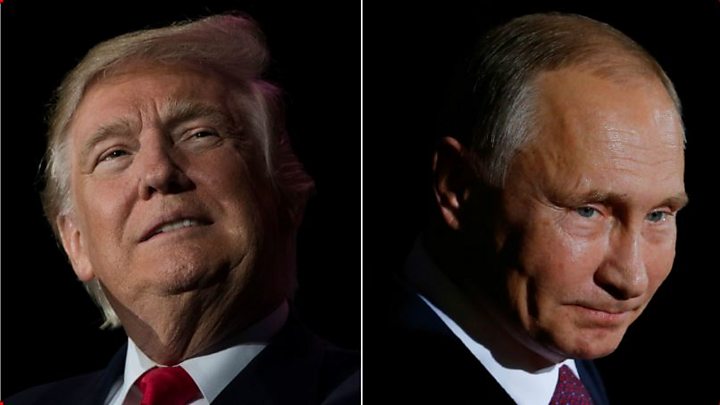
The US has published a list of 114 Russian politicians and 96 oligarchs, some close to the president, as part of a sanctions law aimed at punishing Russia for meddling in the US election.
The US stressed those named had not been hit with new sanctions, although some have already been targeted.
Congress passed the sanctions law in August. President Donald Trump signed it while making his reservations clear.
The Kremlin said the list could damage the reputation of those named.
The law aimed to punish Russia for its alleged meddling in the 2016 US elections and its actions in Ukraine.
Congress wanted the list to name and shame those who had benefited from close association with President Vladimir Putin and put them on notice that they could be targeted for sanctions, or more sanctions, in the future.
Who has been named?
Informally known as the “Putin list”, the unclassified section has 210 names, 114 of them in the government or linked to it, or key businessmen. The other 96 are oligarchs apparently determined more by the fact they are worth more than $1bn (£710m) than their close ties to the Kremlin.
The political/business list includes Prime Minister Dmitry Medvedev, Foreign Minister Sergei Lavrov, Defence Minister Sergei Shoygu and the CEOs of Gazprom, Rosneft and Aeroflot.
The oligarchs named include Roman Abramovich, Oleg Deripaska, Yuri Milner and Alisher Usmanov.
Will they be sanctioned?
Not at the moment. The US Treasury document itself stresses: “It is not a sanctions list, and the inclusion of individuals or entities… does not and in no way should be interpreted to impose sanctions on those individuals or entities.”
It adds: “Neither does inclusion on the unclassified list indicate that the US Government has information about the individual’s involvement in malign activities.”
However, there is a classified version said to include information detailing allegations of involvement in corrupt activities.
What is the Caatsa act and did the president want it?
The law limited the amount of money Americans could invest in Russian energy projects and made it more difficult for US companies to do business with Russia.
It also imposed sanctions on Iran and North Korea.
In signing the act, Mr Trump attached a statement calling the measure “deeply flawed”.
“As president, I can make far better deals with foreign countries than Congress,” he said.
Under Caatsa, the list of names had to be delivered by Monday. The fact it was released about 10 minutes before midnight may reflect Mr Trump’s coolness towards it, and his opposition to punishing more Russians with sanctions.
Earlier in the day, the US government argued the Caatsa law had already pushed governments around the world to cancel deals with Russia worth billions, suggesting that more sanctions were not required.
“From that perspective, if the law is working, sanctions on specific entities or individuals will not need to be imposed because the legislation is, in fact, serving as a deterrent,” state department spokeswoman Heather Nauert said.
The reaction this time has ranged between deep anger and a more measured approach.
Media playback is unsupported on your device
Kremlin spokesman Dmitry Peskov, who is himself on the list, accepted that it was not one of sanctions but added: “Publication of such a wide list of everything and everyone could potentially damage the image and reputation of our firms, our businessmen, our politicians and of members of the leadership.”
He added: “It’s not the first day that we live with quite aggressive comments made towards us, so we should not give in to emotions.”
Russian lawmaker Vladimir Dzhabarov said the inclusion of almost the entire leadership of the country was a de facto severing of relations.
LaVonne Moore has Alzheimer’s disease, but her doctors hope her dementia symptoms could possibly be kept in check by a new type of treatment.
Electric wires implanted deep in her brain stimulate areas involved with decision-making and problem-solving.
Unlike many long-term dementia patients, LaVonne, 85, can cook meals, dress herself and organise outings.
But it remains unclear whether her deep brain stimulation (DBS) therapy is responsible for her independence.
DBS is already helping hundreds of thousands of patients with Parkinson’s disease to overcome symptoms of tremor, but its use in Alzheimer’s is still very experimental.
Only a small number of DBS studies have been done for Alzheimer’s and they have focused on stimulating brain regions governing memory, rather than judgement.
But Dr Douglas Scharre and colleagues at the Ohio State University Wexner Medical Center believe their approach, which targets the decision-making frontal lobe of the brain, might help patients keep their independence for longer.
Deep brain stimulation
Involves permanently implanting very fine wires, with electrodes, into the brain, under anaesthetic
The wires are connected to a pulse generator (pacemaker) under the skin of the chest wall
The device delivers electric stimulation to the brain to improve function or reduce symptoms
LaVonne’s brain pacemaker was implanted three and a half years ago.
Since then, her husband, Tom, from Delaware, Ohio, says her dementia has worsened – but more slowly than he had expected.
“LaVonne has had Alzheimer’s disease longer than anybody I know, and that sounds negative, but it’s really a positive thing because it shows that we’re doing something right.”
Two other patients have had the same treatment as LaVonne, but only one of them appeared to benefit significantly, according to the Journal of Alzheimer’s Disease.
Experts say it is too early to say if the treatment will help counteract cognitive decline.
Larger trials
Neurosurgery expert Prof Andres Lozano, who has been conducting his own DBS trials in Alzheimer’s patients in Canada, said: “We desperately need a novel treatment for Alzheimer’s.
“This may seem bold and aggressive to some, but it is promising. Studies so far show it is safe.
“We’ve got patients with Parkinson’s who have had these devices inside of them for 30 years with no problems.
“Although we are not talking about treating the Alzheimer’s degeneration, we can look at changing the downstream consequences by turning parts of the brain back on.”
Dr Carol Routledge from Alzheimer’s Research UK, said: “The study did not compare against a dummy treatment and so while signs of benefit are worthy of follow-up, the full benefits and cost-effectiveness of this treatment need much more robust investigation in larger trials.”