Michelin lets top chef pull out of guide

A prestigious food guide has allowed a top French restaurant to publicly withdraw from its listings.

Sebastien Bras’s Le Suquet restaurant in southern France held Michelin’s three-star rating for 18 years.

He shocked the food world in September when he decided to give up his top rating, saying he no longer wanted to cook under the “huge pressure” of being judged by its inspectors.

It is the first time Michelin has ever allowed a restaurant to bow out.

“It is difficult for us to have a restaurant in the guide which does not wish to be in it,” Michelin spokesperson Claire Dorland Clauzel told AFP news agency. She said other restaurants had dropped out when chefs retired or the concept had changed.

What did Mr Bras say exactly?

The gastronomic bible’s decision comes after Mr Bras, 46, spoke out about no longer being able to deal with knowing that just one below-par dish could jeopardise his reputation.

“You’re inspected two or three times a year, you never know when,” he told AFP.

“Every meal that goes out could be inspected. That means that every day one of the 500 meals that leaves the kitchen could be judged.”

Mr Bras’s famed restaurant in Laguiole will not be featured in the 2018 edition of the Michelin guide to be published next Monday.
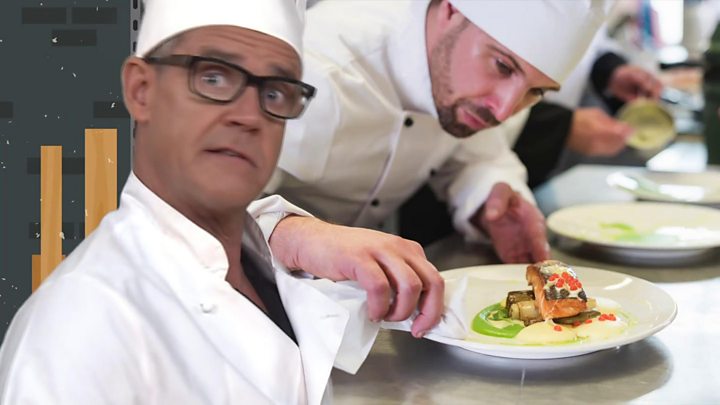
Media playback is unsupported on your device

What does it take to reach star quality?

Originally published in 1900 to guide French motorists to find food and lodging on the road, the Michelin guide is now exclusively dedicated to fine dining.

To be in for a chance of one of the coveted stars, restaurants first have to be in a region Michelin covers. In 2016, it made history by releasing its first-ever Singapore edition, in which it awarded stars to street stalls for the first time.

Researchers for the secretive organisation whittle down the best-reviewed restaurants by food bloggers and critics, and only after scouts draft a shortlist, do inspectors make anonymous visits to evaluate the food.

One Michelin star represents a “very good restaurant in its category”, while two stars denotes a restaurant boasting “excellent cooking” that is “worth a detour”. Three stars, however, is the ultimate honour, afforded only to those restaurants that offer “exceptional cuisine” that is “worth a special journey”.

How great is the pressure on top chefs?

It is not clear what the exact recipe is to receive a recommendation or star – but chefs have been chasing these accolades for decades.

Currently, 27 French restaurants are in the elite club of holding Michelin’s maximum three-star rating.

Mr Bras, who took over his three-star restaurant from his father Michel Bras almost a decade ago, accepts that by relinquishing his stars, “maybe I will be less famous”.

Le Suquet was dubbed “spellbinding” by Michelin’s guide and currently commands a price of up to €230 (£202; $285) for its fixed menus. Its chef says he is keen to “start a new chapter” in his restaurant’s history, away from the ultra-competitive world of Michelin-star cooking.

He hopes he will soon be able to present tantalising dishes “without wondering whether my creations will appeal to [the] inspectors”.

He confessed that, like “all chefs”, he sometimes thought of fellow Frenchman Bernard Loiseau, who took his own life in 2003. Mr Loiseau took 10 years to achieve three stars and his death was widely linked to rumours that he would lose his third Michelin star.

You might also like:

While Mr Bras’s restaurant is the first to be removed voluntarily from the Michelin guide, it is not the first luxury eatery to shed its stars:

  • In 2005, the late Alain Senderens said he’d had enough of the agony of perfection and closed his three-star Art Nouveau Paris restaurant. He is quoted as saying he wanted to do “beautiful cuisine without all the tra-la-la and chichi”
  • Olivier Roellinger closed his lavish Breton restaurant three years later, saying he wanted a quieter life
  • Finally, Danish chef Rene Redzepi forfeited the two stars he won for his Noma restaurant last year. He closed the eatery in order to move it to another part of Copenhagen, saying it was “necessary to break down a castle in order to build a new one”
The New Warriors Explained

The New Warriors may not be as well-known as fellow Marvel teams like the Avengers or Fantastic Four, but they could be getting a major profile boost soon thanks to the proposed TV series based on the comic. Now’s probably a good time to make sure you know your Speedball from your Night Thrasher!

So read on to learn everything you need to know about the history of this teen superhero team.

At their most basic level, the New Warriors are the Teen Titans to the Avengers’ Justice League. The team is comprised of younger heroes who show great promise but aren’t quite ready for prime time yet.

One of the things that sets the New Warriors apart from other teen teams like the Teen Titans and Young Avengers is that they generally aren’t former sidekicks or younger variations of other heroes. In almost every case, they have their own, unique superhero identity and a desire to make a name for themselves. And thanks to their leader, Night Thrasher, the team has been carefully assembled to take on the biggest threats the Marvel Universe has to offer.

Continue reading…

Ant-Man and the Wasp Trailer Released

Marvel Studios has released the first trailer for Ant-Man and the Wasp.

The trailer (click the video above to watch) features Evangeline Lilly’s Hope van Dyne/the Wasp in action along with Paul Rudd’s Scott Lang/Ant-Man. Michael Douglas also makes his return as Dr. Hank Pym, with the trailer also giving a briefing look at the film’s villain Ghost. (Learn more about who Ant-Man’s villain Ghost is right here.)

Ant-Man and the Wasp opens in theaters on July 6. The sequel is directed by Peyton Reed, who helmed the first Ant-Man, and also stars Michael Pena, Hannah John-Kamen, Michelle Pfeiffer, Laurence Fishburne, and several others.

Continue reading…

Battlefield 1 Apocalypse DLC Coming Next Month

Battlefield 1’s fourth expansion, Apocalypse, has been detailed, with new weapons, gadgets, maps, and modes coming to the game in February.

The official update laid out the content we can expect in the last of four planned expansions for the game. There are five mutliplayer maps, two of which have been “created exclusively for aerial combat,” where you can make the most of the new Air Assault game mode.

Continue reading…

Woman sues Japan over forced sterilisation

A Japanese woman who was forcibly sterilised in the 1970s at the age of 15 is suing the government in the first case of its kind.

The unnamed woman is one of 25,000 people who underwent the procedure under a now-defunct eugenics law.

The victims were sterilised because they were found to be mentally ill or have conditions such as leprosy.

About 16,500 of them were allegedly operated on without consent. Some were as young as nine at the time.

The woman, who is now in her 60s, took legal action after learning she had been sterilised in 1972 after a diagnosis of “hereditary feeble-mindedness”.

She had developed mental problems after having surgery for a cleft palate as a baby, Japanese media report.

Due to side-effects from the sterilisation, she later had to have her ovaries removed.

The woman is said to be seeking 11m yen ($101,000; £71,000) in damages, citing the violation of her human rights.

“We’ve had agonising days… we stood up to make this society brighter,” her sister told a press conference.

Japanese Health Minister Katsunobu Kato has refused to comment on the case, saying he does not know the details.

An official from the health ministry told AFP news agency that the government would meet individually with victims of forced sterilisation who needed support, but “has no plans to offer blanket measures” to all of them.

The eugenics law under which the operations happened was in place from 1948 to 1996.

The governments of Germany and Sweden, which had similar eugenics policies, have apologised to victims and paid compensation.

Putin says US list targets all Russians

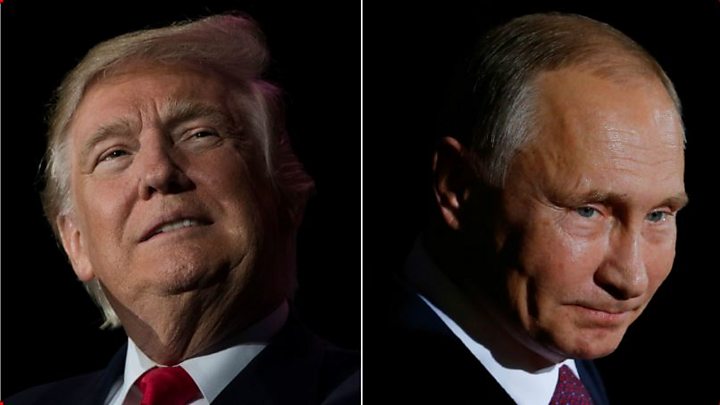
Russian President Vladimir Putin says a list of officials and businessmen close to the Kremlin published by the US has in effect targeted all Russian people.

The list names 210 top Russians as part of a sanctions law aimed at punishing Moscow for meddling in the US election.

However, the US stressed those named were not subject to new sanctions.

Mr Putin said the list was an unfriendly act that complicated US-Russia ties but he said he did not want to escalate the situation.

Mr Putin said Russia should instead be thinking about “ourselves and the economy”.

Why did the US publish the list?

The government was required to draw up the list after Congress passed the Countering America’s Adversaries Through Sanctions Act (Caatsa) in August.

The law aimed to punish Russia for its alleged meddling in the 2016 US presidential election and its actions in Ukraine.

Congress wanted the list to name and shame those who had benefited from close association with President Putin and put them on notice that they could be targeted for sanctions, or more sanctions, in the future.

President Donald Trump did not support Caatsa, even though he signed it into law, saying it was “unconstitutional”.

Under the law, the list had to be delivered by Monday. The fact it was released about 10 minutes before midnight may reflect Mr Trump’s coolness towards it, and his opposition to punishing more Russians with sanctions.

The top Democrat on the House Foreign Affairs Committee, Eliot Engel, accused the Trump administration of letting “Russia off the hook again” by not taking substantial action.

Who has been named?

Informally known as the “Putin list”, the unclassified section has 210 names, 114 of them in the government or linked to it, or key businessmen. The other 96 are oligarchs apparently determined more by the fact they are worth more than $1bn (£710m) than their close ties to the Kremlin.

Most of Mr Putin’s longstanding allies are named, many of them siloviki (security guys). They include the spy chiefs Alexander Bortnikov of the Federal Security Service (FSB) – which Mr Putin used to run – and Sergei Naryshkin of the Foreign Intelligence Service (SVR).

The men who control Russia’s energy resources are listed: Gazprom chief Alexei Miller, Rosneft chief Igor Sechin and other oil and gas executives, along with top bankers like Bank Rossiya manager Yuri Kovalchuk.

The oligarchs include Kirill Shamalov, who is reported to be Mr Putin’s son-in-law, although the Kremlin has never confirmed his marriage to Katerina Tikhonova, nor even that she is the president’s daughter.

Internationally known oligarchs are there too, such as those with stakes in top English football clubs: Alisher Usmanov (Arsenal) and Roman Abramovich (Chelsea).

Will they face new sanctions?

Not at the moment. The US Treasury document itself stresses: “It is not a sanctions list, and the inclusion of individuals or entities… does not and in no way should be interpreted to impose sanctions on those individuals or entities.”

It adds: “Neither does inclusion on the unclassified list indicate that the US government has information about the individual’s involvement in malign activities.”

However, there is a classified version said to include information detailing allegations of involvement in corrupt activities.


What does it mean for Russia’s elite?

Analysis: Steve Rosenberg, BBC Moscow correspondent

The good news for the Kremlin: this isn’t a sanctions list. But the good news ends there.

Those Russian officials and oligarchs named by the US Treasury will worry that their inclusion could signal sanctions in the future.

Even before the list was made public, the Kremlin had claimed the US Treasury report was an attempt to meddle in Russia’s presidential election.

The list reads like a Who’s Who of the Russian political elite and business world.

Moscow won’t want that to become a Who’s Sanctioned.


What is the Caatsa act and did the president want it?

The law limited the amount of money Americans could invest in Russian energy projects and made it more difficult for US companies to do business with Russia.

It also imposed sanctions on Iran and North Korea.

Media playback is unsupported on your device

In signing the act, Mr Trump attached a statement calling the measure “deeply flawed” and said he could make “far better deals with foreign countries than Congress”.

Earlier on Monday, the US government argued the Caatsa law had already pushed governments around the world to cancel deals with Russia worth billions, suggesting that more sanctions were not required.

How have the Russians reacted?

Perhaps referring to the fact that all of their political representatives had been named, Mr Putin said that, in effect, “all 146 million Russians have been put on the list”.

He joked he was offended not to be named himself.

Earlier, Kremlin spokesman Dmitry Peskov, who is himself on the list, accepted that it was not one of sanctions but said it could potentially damage “the image and reputation” of figures listed and their associated companies.

He added: “It’s not the first day that we live with quite aggressive comments made towards us, so we should not give in to emotions.”

When Caatsa was passed, PM Dmitry Medvedev said it meant the US had declared a “full-scale trade war” on Russia.

Russian opposition leader Alexei Navalny praised the publication of the names as “a good list”.

Krasinski on the Silent Terror of A Quiet Place – IGN First

All month long, IGN First is spotlighting the Films to Watch in 2018. Today, we take a look at A Quiet Place – a unique new supernatural suspense thriller written and directed by The Office’s John Krasinski, starring Krasinksi and Emily Blunt as a couple who must raise their children in silence because the mysterious monsters who surround their farm are attracted to noise. This Paramount Pictures release lands in theaters April 6th.

Set on a desolate homestead where a father, mother, son, and daughter must live lives of utter silence so as to not attract a sound-sensitive supernatural evil that lurks in the surrounding forest, A Quiet Place, from John Krasinski, aims to haunt us with hushed tones. Dialogue-free, this film is already terrorizing theatergoers with its trailer as real life husband and wife, Krasinski and Emily Blunt, play the couple who must keep their children safe while not not making a peep.

Continue reading…

Star Wars Comics: Marvel and Lucasfilm’s Duel of Philosophies

Darth Vader learning it was his son Luke Skywalker who destroyed the Death Star. The surprise introduction of Han Solo’s supposed wife. And Princess Leia finding the last remaining citizens of Alderaan. These are key moments in Star Wars lore, but they’re not in any of the movies. They’re all products of Marvel Comics’ line of Star Wars comics that kicked off in 2015 and have been making contributions to the canon ever since. But even though these Star Wars comics have been a hit with fans and are selling quite well, it required two media juggernauts, Marvel and Lucasfilm, to learn to work together even though they have a very different way of doing things.

Continue reading…

VW takes blame for monkey exhaust tests

Volkswagen has taken responsibility for diesel emissions tests on humans and monkeys amid mounting fury.

VW chief executive Matthias Mueller said the German car maker had “taken first consequences” for the tests.

He said the animal testing was “wrong … unethical and repulsive”, Spiegel Online reported.

VW has suspended its chief lobbyist Thomas Steg, who admitted to knowing in advance about the monkey experiment, which took place in New Mexico in 2014.

He said “what happened should never have happened, I regret it very much” and took “full responsibility”.

The exhaust fume tests were carried out by EUGT, a now disbanded body that had been funded by VW as well as rivals Daimler, which owns Mercedes Benz, and BMW.

Last week the New York Times reported that EUGT had exposed 10 monkeys to fumes – in an air-tight chamber – from several cars, including a diesel VW Beetle, at a lab in Albuquerque.

In his first public comments on the test, Mr Mueller said: “The methods used by EUGT in the United States were wrong, they were unethical and repulsive. I am sorry that Volkswagen was involved in the matter as one of the sponsors of EUGT.”

Germany’s Stuttgarter Zeitung and SWR radio reported that 19 men and six women had inhaled diesel fumes in another EUGT experiment.

The German government has called a meeting with the car makers to seek an explanation for the experiments, which have been condemned by politicians and animal rights activists.

The controversy follows a scandal over software that falsified diesel exhaust data for Volkswagen cars.

In 2015 VW admitted having fitted “cheat” devices in the US that made its engines appear less polluting than they actually were.

The scandal has cost Volkswagen almost $30bn.

Last month former VW executive Oliver Schmidt was sentenced to seven years in prison in the US and a $400,000 (£293,000) fine after admitting he helped the firm evade clean-air laws.

Saudi anti-corruption drive nets $106bn

A sweeping anti-corruption drive in Saudi Arabia has generated an estimated $106.7bn (£75.6bn) in settlements, the kingdom’s attorney general has said.

Sheikh Saud al-Mojeb said 56 of the 381 people called in for questioning since 4 November remained in custody.

The others had been cleared or admitted guilt and handed over properties, cash, securities and other assets, he added.

Sheikh Mojeb did not name any of those involved, but they reportedly include princes, ministers and businessmen.

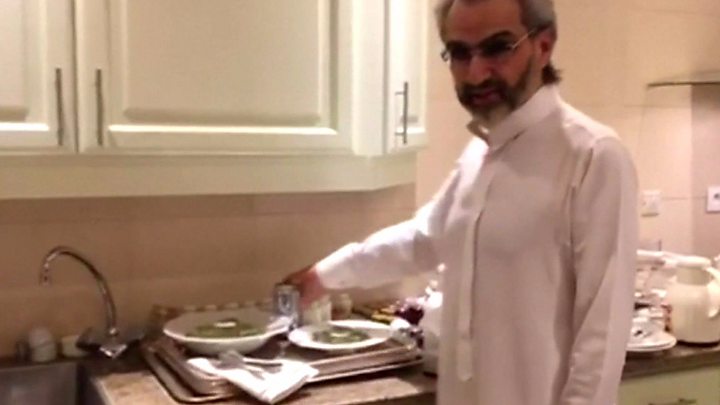
In recent days, the billionaire investor Prince Alwaleed bin Talal and Alwalid al-Ibrahim, owner of the Arab satellite television network MBC, were released from detention at the Ritz-Carlton Hotel in Riyadh’s diplomatic quarter.

Media playback is unsupported on your device

Both men insisted they were innocent, but Saudi official sources said they had agreed to financial settlements after admitting unspecified “violations”.

Others known to have been freed include Prince Miteb bin Abdullah, a son of the late King Abdullah who sources said had handed over more than $1bn in assets; and state minister Ibrahim al-Assaf, who was reportedly cleared of any wrongdoing.

Sheikh Mojeb said he had “refused to settle” with the 56 individuals still being detained “due to other pending criminal cases, or in order to continue the investigation process”.

They are believed to have been transferred to prison from the Ritz-Carlton, which will reopen to the public next month.

Last week, Finance Minister Mohammed al-Jadaan said the money recovered through the settlements would be used to fund a $13.3bn programme to help Saudi citizens cope with the rising cost of living.

The anti-corruption drive is being spearheaded by Crown Prince Mohammed bin Salman, the 32-year-old son of King Salman, who has rejected as “ludicrous” analysts’ suggestions that it is a power grab. He said many of those detained had pledged allegiance to him since he became heir apparent in June.