Learn more about Nintendo’s interesting feature of its upcoming Nintendo Labo line.
A Complete Guide to EA Sports UFC 3’s Preorder Bonuses
UFC 3 comes with a variety of digital goods in its different editions. We’ve broken it all down for you, so read up before you buy.
Guest Column: What’s the Real Value of a Video Game?
In the wake of Microsoft’s Game Pass news, a former Irrational developer weighs in on the shifting tides in the industry.
What Trailers Can You Expect At This Year’s Super Bowl?
It’s that time of the year again, when the NFL hosts its final football game of the season–the Super Bowl–and the vast majority of non-NFL fans get together to watch brand new commercials and movie trailers. This year’s event should have quite a few big trailers during the big game, as studios are willing to pay $5 million for a 30-second commercial break slot.
Get ready to see some early looks at this year’s biggest summer blockbusters. Here’s what we could possibly be seeing during this year’s event, as you patiently await for a time out on the field.
Black Panther Behind-The-Scenes Video Shows Intense Fight Scenes Were Done Without CGI
In the age of comic book movies, CGI is pretty commonplace. Whether it’s the villains, lush landscapes, or the suits worn by the superheroes themselves, sometimes it seems as if everything on the big screen during these movies is done through computer animation.
Black Panther will, no doubt, have a lot of CGI in it. between T’Challa’s (Chadwick Boseman) suit and powers, the creation of Wakanda, and the futuristic technology on display, it would be impossible not to. However, a new look behind the scenes of the upcoming Marvel Cinematic Universe film shows one piece of the puzzle that director Ryan Coogler has done as practically as possible–the massive fights.
In the short clip, which surfaced on Reddit, the Black Panther can be seen delivering a strong jumping kick to one of his foes in Wakanda, only for the man on the receiving end to go flying backward. This is made possible through the use of wires, which yank the stunt performer getting kicked through the air, while the people of Wakanda continue to fight in the background.
While clearly the footage will be manipulated with computers–to remove the wires and fill in what’s being covered by blue screen–it’s an impressive sight to behold. This is a scene that certainly could have been done using computer animation, but nearly every time CGI is used for these moments, it’s quite obvious. Instead, the epic moment plays out as dozens of actors and stunt performers wage war, while the Black Panther joins the fray.
How the scene turns out in the movie–and what it means for the people of Wakanda–remains to be seen. Luckily, Black Panther will be in theaters on February 16, so you won’t have to wait long to find out.
Got a news tip or want to contact us directly? Email news@gamespot.com
Trump’s USDA Could Make Hog Workers’ Jobs Even More Dangerous
The U.S. Department of Agriculture is pushing forward with a proposed rule that would forego line-speed limits in hog processing plants, a move that could endanger the well-being of workers and consumers, activists say.
The proposal is part of the USDA’s effort to “modernize” the swine industry, the organization announced earlier this month. These plants, which already work at feverish speeds of up to 1,106 hogs per hour, would likely use the change as an opportunity to further increase the pace of production.
In addition to increasing line speeds, the proposal would allow employees to take over some of the oversight duties that USDA inspectors currently handle on the kill lines.
The way it works now, USDA inspectors are expected to examine every animal that comes down the line, and are tasked with identifying diseased hogs and visible fecal matter. Under the proposed rule, plant employees would take over that job before the carcasses reach federal inspectors.
The move could potentially help the hog industry’s bottom line. But faster speeds could also put consumers at risk, since inspectors may not be able to examine each carcass adequately for diseases and other issues. Increasing the rate of speed lines could present more risks for plant workers who already face a slew of hazards at the industry’s current pace, including amputations and musculoskeletal injuries, such as carpal tunnel syndrome.
But the USDA maintains that it’s not its responsibility to ensure worker safety ― that’s up to the Occupational Safety and Health Administration, said Carmen Rottenberg, deputy administrator at the Food Safety and Inspection Service at USDA.
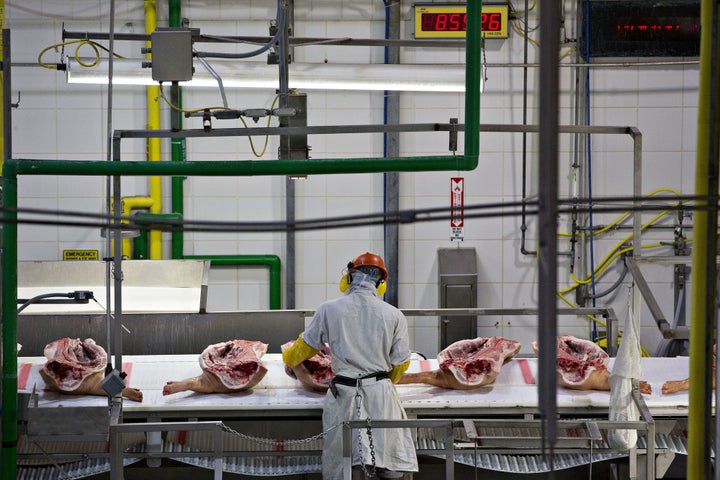
The proposal is “a gift to the industry,” said Tony Corbo, senior lobbyist with Washington-based advocacy group Food & Water Watch. “The industry has been pushing to deregulate inspection all the way back to the Reagan administration.”
Corbo added that while the proposed rule fits in with the Trump administration’s “deregulatory talk,” the concept actually precedes the current presidency.
During the Obama administration, the USDA approved a similar plan for poultry plants in 2014. But after getting bombarded with pushback from activists and the media, the government organization decided to prohibit plants from ramping up the speeds on slaughter lines.
Rottenberg told HuffPost that the revised protocol would increase efficiency and free up USDA inspectors to perform other tasks around the hog plants.
The organization pointed to the “success” of a pilot program that started in the late 1990s, which allowed five hog plants to operate as their own designated speeds.
“For large-volume establishments, this new swine inspection system does make better use of the agency’s resources while also removing unnecessary regulatory obstacles to industry,” said Rottenberg.
But a 2013 report from the Office of the Inspector General harshly criticized the USDA for its lack of oversight of pork slaughterhouses in general, and took issue with the five plants involved in the pilot program in particular.
The report concluded that between 2008 and 2011, three of the 10 plants with the most citations for food safety and animal welfare violations were part of the USDA pilot program. Those plants, which had 50 percent more citations than the plant with next highest number, continue to run at the same speeds.
Workers’ advocates also say that faster line speeds will make an already dangerous job even more dangerous.
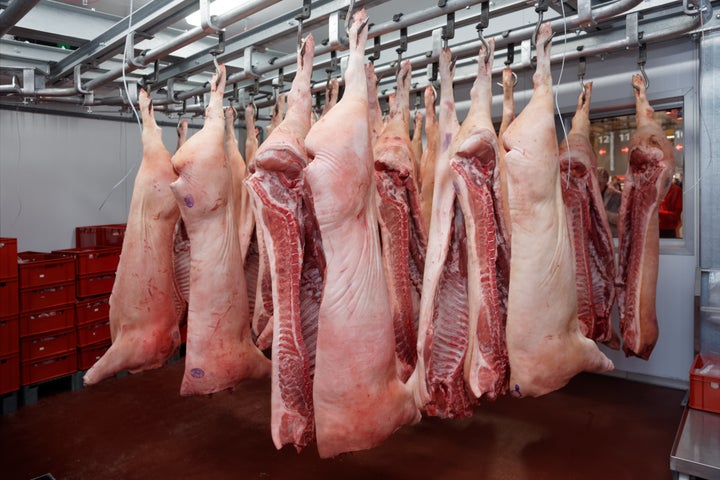
Serious injuries ― those that require work restrictions or days off from work ― are more than three times higher in meat packing than other U.S. industries, according to the Bureau of Labor Statistics.
While protecting workers is not within the USDA’s regulatory purview, activists say that workers at slaughterhouses – who are often refugees and immigrants that are reluctant to speak up about hazardous conditions ― rely on USDA’s rules to keep them safe.
“Food safety regulations have acted as a de facto throttle on line speeds, and has consequently protected workers,” said Nicole Civita, a lawyer, professor, food ethicist and director of the Food Recovery Project.
Before moving forward with the proposed rule, the USDA will accept comments from the public for 60 days, through mid-March. Earlier this week, the USDA rejected a petition from the National Chicken Council requesting that poultry processing plants be allowed to do away with line speed maximums.
Activists say there’s no difference between the poultry and hog industries: If the USDA rejected the idea of increasing line speed for chickens, they should also reject it for hogs for the same reasons.
“Do people really want to eat meat that has not been properly processed? What if they find toenails in their hot dogs, or if hogs were diseased and haven’t been caught because the lines are moving so fast?” Corbo said. “Operating at these excessive line speeds without having adequate inspection will put more product into commerce [and] on people’s tables that are unsafe and not wholesome to eat.”
Protesting While Muslim Comes With Its Own Set Of Judgments
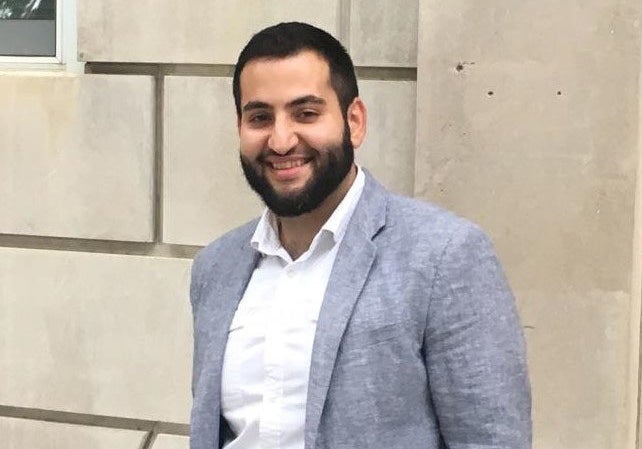
When Bilal Askaryar woke up on the morning of Feb. 10 last year, he wasn’t expecting to get arrested. But it was a risk he was willing to take.
It was a cold winter’s day in Washington, a city still buzzing from the spirit of historic civic protests. Just a few weeks earlier, hundreds of thousands of people gathered on the National Mall to defend women’s rights. Days later, activists flocked to Washington Dulles International Airport and marched through the nation’s capital to protest President Donald Trump’s executive order that sought to ban immigration from seven Muslim-majority nations and temporarily halt refugee resettlement programs.
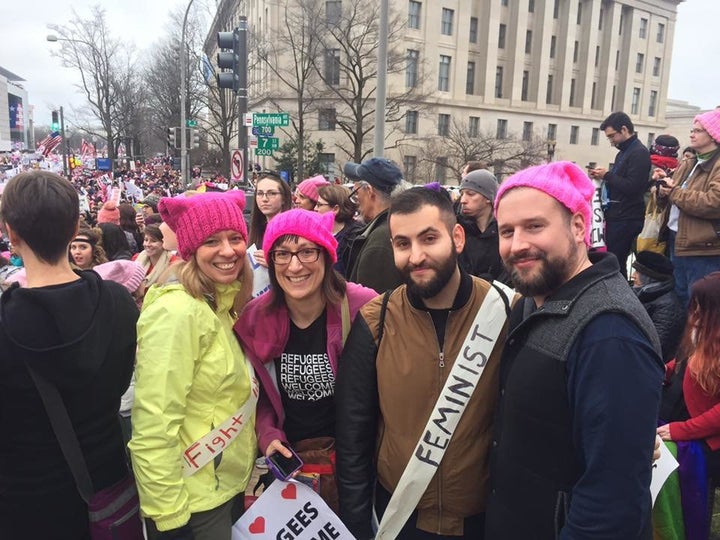
Askaryar is a 32-year-old communications specialist who lives in D.C. and who believes strongly in the right of Americans to participate in protests and, when necessary, in acts of civil disobedience. He participated in the Women’s March and in protests against Trump’s plans to restrict refugee immigration. That February morning, Askaryar briefly contemplated staying in his warm bed and skipping another, smaller protest set to take place at a local public school. But his conscience tugged at him.
“I didn’t want to be one of those people that opposes everything on social media or in dinner conversations among friends, but doesn’t actually do anything about it, when it comes down to it,” he told HuffPost. “I’m going to put my body on the line for those who can’t.”
Askaryar said that in the hours that followed his decision to attend, he came to believe that engaging in civil disobedience as a Muslim can carry with it certain hazards.
He said he ended up the only person facing legal charges for his actions that day, although he claims others at the protest were more combative with police officers at the scene. (The initial Washington Post story on the protest reported that one person was arrested, without providing a name.)
In subsequent stories on Askaryar’s case, media outlets honed in on his ethnicity and his place of birth ― Afghanistan. That was information he doesn’t think would have been spotlighted if he was a white protester.
The U.S. Muslim community is heavily composed of immigrants and the children of immigrants from around the world. While native-born Muslims have been involved in civil rights demonstrations and other forms of political activism in the U.S. for decades, the newer wave of Muslim immigrants and their children, who hail primarily from South Asia, the Middle East and North Africa, are experiencing a political awakening. They’re running for office, forming new activist organizations and getting involved in intersectional activism.
But in a time when anti-Muslim hate crimes are spiking and Islamophobic rhetoric flows from the highest political offices in the land, these Muslims find themselves having to defend their identity as Americans.
Askaryar considers it ironic that while participating in civil disobedience, an act he believes is “the highest form of patriotism,” he had to contend with being portrayed as the “other.”
As the story of his arrest gained traction, Askaryar said he felt a sense of panic, and then disillusionment.
“I’d like to believe that every American citizen has a right to make his or her voice known and to fully exercise their First Amendment rights,” he said. “But in this case, it’s not true.”
“Where Were You Born?”
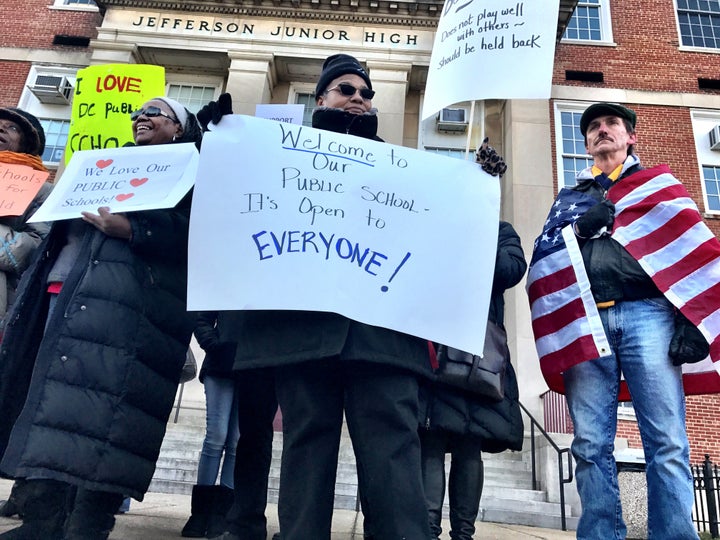
The night before Feb. 10, Askaryar heard on social media about a Black Lives Matter protest planned for Jefferson Middle School Academy in Washington. The BLM protesters and other local groups wanted to express their discontent with Trump’s new education secretary, Betsy DeVos, who was visiting the school. Askaryar and other Devos critics view her policies as detrimental to public schools.
When he arrived for the demonstration, Askaryar said he and others learned that DeVos’ team was trying to avoid confronting members of the local teachers’ union, who were protesting at the building’s front entrance. The BLM protesters positioned themselves at a side entrance, to force DeVos to enter through the front.
In a video, Askaryar (wearing a black jacket and gray beanie) is seen with another protester physically blocking DeVos from using the side entrance. Holding a Black Lives Matter sign, the activist shouts “Shame” as the education secretary retreats back into her car.
In the ensuing altercations with police, Askaryar said that, like him, other protesters were resisting officers’ instructions. Some demonstrators planted themselves in front of DeVos’ vehicle and refused to budge.
Yolanda C. Rondon, a lawyer with the American-Arab Anti-Discrimination Committee, was acting as a legal observer at the protest. She told HuffPost she wasn’t sure if police singled out Askaryar for arrest ― “I’m not inside the police officer’s mind,” she said.
But she does think Askaryar could have stood out to officers because of the way he looked. The police department had previously dealt with the BLM protesters, Rondon said. And most of the members of the National Lawyers Guild who joined in the protest were white, she said.
Officers “probably saw Bilal and saw that he’s not part of [those groups] and thought he’s just a troublemaker … here to start some stuff,” Rondon said. “They probably did treat him differently because he wasn’t black and he wasn’t white.”
Askaryar was charged with two counts of assault on a police officer, one count of failure to obey a lawful order, and one count of unlawful assembly and disorderly conduct.
All the charges were dismissed by a D.C. Superior Court judge in November.
Askaryar said he believes the risk of being arrested goes with participating in civil disobedience. But there was one part of his encounter with the police that caused him to worry.
He said one of the first things an officer asked him while he was being arrested was, “Where were you born?”
It’s when he heard this question that he said he started to feel scared.
“Being arrested was fine. I mean, I wasn’t planning on it. But there are worse things than spending a night in D.C. jail,” he said. “The thing that was actually scary was that the police immediately went to, ‘Where were you born,’ and assuming that I wasn’t a U.S. citizen.”
“I saw then that they think that’s relevant. And I knew I was in a sensitive situation because I happen to have been born in Afghanistan, which is a Muslim-majority country which people associate with scary things.”
Asked to comment on Askaryar’s allegations of bias, Hugh Carew, a spokesperson for Washington’s Metropolitan Police Department, told HuffPost that “if anyone believes that they were treated inappropriately by an MPD officer, we urge them to file a complaint with MPD or the Office of Police Complaints so the matter can be fully investigated.”
Askaryar said he’s not interested in pursuing that course of action. But he also said that for him, the arrest was only the beginning of the story.
An American Citizen Defends His American Identity
Days after Askaryar’s arrest, he said he grew concerned about coverage of his case by local and national media. Along with defending himself against the charges, he found himself having to defend his American identity.
Askaryar’s family came to the U.S. as political refugees in the 1990s, when he was just 5 years old. Askaryar has since become an American citizen. A few weeks before his arrest, he’d published an essay on NPR about his family’s past, and America’s moral duty to continue to take in refugees fleeing persecution.
After his arrest, Askaryar noticed something curious. In a follow-up story on him, the Post highlighted that he came to the country as a refugee ― even making it the focus of the piece’s headline. The Post also contacted Askaryar’s father in California to ask about the family’s background and his son’s possible motives.
Askaryar doesn’t think white, non-Muslim activists arrested during acts of civil disobedience would have their family’s immigration history detailed in this way.
“How many times when white protesters get arrested do people think to call their parents? Or ask their parents about their ethnic background and motivations?” Askaryar said. “Everything about the coverage of my participation in the non-violent civil disobedience was framed as immigrant or refugee arrested for assault. That’s not how we talk about Caucasians who get arrested on civil disobedience.”
The Post’s reporting was picked up on other sites, including right-wing outlets Gateway Pundit and PJ Media. The sites narrowed in on Askaryar’s former status as a refugee. They also highlighted his sexual orientation, based on an article he had written for The Washington Blade, a queer online magazine in D.C.
He said he began receiving online backlash from right-wing commentators, with some calling for him to be sent back to Afghanistan.
Reading headlines like “Gay Refugee from Afghanistan Charged with Assault for Blocking Betsy DeVos” and “Afghan refugee pleads not guilty to charges following DeVos protest at D.C. school,” Askaryar said he began feeling fearful about his safety and the safety of his family. He was also concerned the publicity would hurt his career prospects.
Most of all, he said he was astonished media organizations thought the fact that he had come to this country as a refugee decades ago was relevant to his protest against DeVos.
Kristine Coratti Kelly, vice president of communications and events at the Post, told HuffPost that because Askaryar and his lawyer declined to speak with the newspaper for its follow-up article, the story relied on his NPR essay “to give readers a sense of who he is. His father confirmed the account, telling us, as we reported, that his son’s motivation in taking part in the protest was to ‘protect education.’”
“It’s ridiculous, I’m an American citizen,” Askaryar said. “I was there because I believe as an American citizen that dissent is the highest form of patriotism. It doesn’t matter where I was born 30-something years ago.”
“If I was there protesting the president of Afghanistan visiting the United States, maybe [his immigration history] would be relevant,” he added. “But I was there protesting the secretary of education of the United States of America.”
He said the only difference he sees in the attention he received “is my ethnic background.”
When Being A Visible Muslim Draws Suspicion
In the years since the 9/11 attacks, Muslim organizations in the U.S. have documented a rise in anti-Muslim hate crimes and rhetoric. There are also more subtle ways in which presenting oneself as a Muslim in society spurs unintended consequences.
Some describe the perils of “flying while Muslim” ― referring to the discrimination and profiling Muslims face while traveling on airplanes. Simple things, like using the word “Allah” or reading a book about Syria, can cause fellow passengers alarm, and sometimes result in Muslims being kicked off flights.
Muslim women describe facing verbal harassment online. Linda Sarsour, an outspoken Muslim activist and one of the leaders of last year’s Women’s March, is often the target of such attacks.
Muslim communities have also been subjected to massive, unwarranted and targeted surveillance by law enforcement ― with officers eavesdropping on conversations, infiltrating student groups, and monitoring sermons in mosques.
Such religious profiling has enflamed already tense relations between American Muslims and law enforcement, Rondon said.
“I think it’s important to note that, similar to the black community, Muslim and Arab communities have had strenuous relationships with the police, particularly because they feel [officers] are only there to police them and not to keep them safe,” she said.
Askaryar said he believes he stood out from the rest of the activists at Jefferson Middle School Academy not because of what he was doing, but because he was a Muslim man with a beard.
Askaryar has sported a beard since 2015. Although he’s a devout Muslim and some Muslims choose to have beards to emulate the Prophet Muhammad, Askaryar said he didn’t grow one because of his faith. Rather, it was simply something he decided to do for aesthetic reasons.
For most of his life, he said, he had been “relatively passing” as an American citizen. But once he had the beard, he said he began to notice a difference in the way he was labeled. People began to “assume maybe this guy is a Muslim or Middle Eastern.”
Blair Imani, a community activist based in Brooklyn, New York, is well acquainted with how appearances associated with being a Muslim can change other people’s perceptions.
Before Imani converted to Islam in 2015, she said she was seen by others only as a black woman during protests in which she participated. But after she began wearing a hijab, she said the heckling she received at demonstrations changed. People started to telling her to “go back to where you’re from” ― even though black Muslims have been in the United States for centuries.
“As a black woman, protest and standing up against police brutality was in the canon of who I was expected to be,” she said. “But once I converted, there’s this foreignness that the Muslim identity is given.”
Mariam Durrani, an anthropologist who studies Muslim youth at Hamilton College in Clinton, New York, agreed that Muslim Americans continue to be seen as foreigners. And because of the current climate of xenophobia and anti-Muslim racism, Muslims Americans ― like other minority groups ― are often held to higher standards when protesting.
“Muslim Americans are expected to be model citizens, which somehow means not being critical of policies or the government,” she told HuffPost.
A Political Awakening In Immigrant Muslim Communities
Black and indigenous Muslim American communities have been speaking up about discrimination for decades. But as the non-native community grows, Durrani said, its youth are starting to see themselves as stakeholders in conversations the country is having about race, class, and gender.
“Today’s activism is intersectional, digital, and begins with the premise that [Muslims] are part of this country and invested in its future,” Durrani said.
The problem is that when Muslim activists engage in protest, the story often becomes more about who is protesting, instead of what is being protested.
That’s what Imani sees when Muslim women protest while wearing the hijab.
“What would make it easier is if our message resonated in a way that honors who we’re protesting … versus, ‘Oh, she was wearing a scarf,’” she said.
Askaryar said his experiences last year haven’t deterred him from wanting to participate in civil disobedience in the future. But he called his arrest and the media coverage of it a “wake-up call.”
“I used to think that I could show up at these Black Lives Matter actions and volunteer because black kids should not be doing this because they’re in a lot more danger than I am,” he said. “But I’ve realized since that that may be true, but it’s also not a good time for Muslims, South Asians, Arab folks to be engaging in these things either.”
As an immigrant and a Muslim, he said he’s experienced discrimination. But this was the first time he really understood the double standard that Muslim activists, and other minority activists, are held to.
“People brashly question, ‘Why is this former immigrant engaging in civil disobedience? If you don’t like this country go back to where you come from.’ That kind of obnoxious, toxic rhetoric is anti-American at its core,” he said. “People have been given license to increasingly question their fellow Americans that have different origins than they do. … We are protesting not because we hate this country, but because we love this country and we want to hold it to the highest ideals that it aspires to.”
Halo 6’s Development Won’t Be Impacted By Ongoing Support For Older Titles
While the next Halo FPS has not been officially announced, we definitely know it is coming. And thankfully, it’s going to have split-screen support. Now we’ve learned even more about the game, or at least its development. In a blog post this week, developer 343 Industries stressed that its ongoing support for Halo: The Master Chief Collection and Halo 5 will not take away resources from “the next Halo FPS title.” A “small but experienced” team at 343 is now working on support efforts for what 343 called “legacy” Halo games.
“This team is completely separate from the broader 343 team working on the next Halo FPS title,” 343 explained. “There’s zero overlap or shared resources to ensure that the larger game team can remain laser focused on the future. I’ve read some posts from fans who are concerned that we’re cracking open MCC at the expense of the next Halo FPS title–rest assured that while MCC is incredibly important to the studio, in no way is this work interfering or taking away from the next big thing. We are committing the necessary resources to do both projects right.”
Back in October, Microsoft spoke frankly about why Halo: MCC struggled and laid out a bold and ambitious plan to address its lingering bugs and improve it on the whole. Because this effort came across as sounding like a serious and time-consuming effort, some believed it would impact the development of the next mainline Halo game. 343 did acknowledge that its ongoing support for Halo: MCC is a “big ambitious project” with a “lot of work to be done.”
In addition to the “small but experienced team” inside 343 working on Halo: MCC, 343 is recruiting the community to help test new features and functionality as part of a “flighting” program that will roll out in phases in due time. In addition, 343 said it is working with “some external support” on this effort, which sounds like a reference to an outside studio.
Finally, 343 talked about some of what it plans to address and add to Halo: MCC over time. This will include updating the matchmaking APIs to improve reliability and make the overall matchmaking experiences–and especially in parties–“much more” reliable. Additionally, 343 is updating the XDK/APIs for all eight of the game engines running under the hood. This includes Halo 1 Classic, Halo 1 Anniversary, Halo 2 Classic, Halo 2 Anniversary, Halo 3, Halo 3: ODST, Halo 4, and Halo 2 Anniversary multiplayer.
“One of the major implications of this work is that the XDK upgrades now allow us to support Xbox One X features such as increased resolution and visual enhancements,” 343’s Andrew Schnickel said. “We can also use platform advancements such as the ‘social manager’, which simplifies a lot of our code around friends and presence management. And foundationally, this update opens the possibility for other things we’d like to explore like custom game session browsing, Xbox Arena, or Mixer support.”
Updating all the engines includes things like “fully retiling textures, recompiling shaders,” and more. When this process is complete, you’ll have to install a “sizable” update, 343 said, adding that it will “definitely be worth it.”
Be sure to read the full, incredibly in-depth blog post on Halo Waypoint to get all the important details on the big new updates coming to Halo: MCC.
Halo: The Master Chief Collection had a very rocky launch in November 2014. An ambitious game that packages together four Halo games and their multiplayer modes, the game struggled mightily out of the gate, with matchmaking times proving extremely lengthy and in some cases not working at all. Microsoft was quick to address the issues and the experience has improved dramatically. Still, Microsoft sees the issues as a “black eye” for the franchise.
It is going on three years now since the last mainline Halo FPS was released, with Halo 5 debuting in October 2015. It is possible that the next Halo FPS will be announced during Microsoft’s E3 2018 briefing, but nothing has been confirmed at this stage.
Got a news tip or want to contact us directly? Email news@gamespot.com
Did You Know There’s a New Stargate Series?
It looks like the Stargate franchise is alive and well. The final trailer for Stargate Origins reveals an Indiana Jones-inspired adventure featuring Nazis, thrilling action, and a formidable young Catherine Langford (Ellie Gall) that Stargate fans will remember from the original film back in 1994. The first episode will be available to stream on February 15th — exclusively on Stargate Command.
Stargate Origins first season will center on the adventures of Catherine and her father, Paul (Connor Trinneer). Set in 1939, 10-years have passed since the discovery of the ancient alien relic and the Langford’s still have no idea how to activate it. When a sinister Nazi occultist named Dr. Wilhelm Brucke starts showing interest in the Stargate project — things go horribly wrong.
Air strike cripples Syria cave hospital
A hospital built under 20m (60 feet) of rock in a rebel-held part of central Syria has been wrecked by a powerful air strike, medical sources say.
They say the hospital in Hama province – regarded as one of the best protected in the country – was put out of service by Thursday’s strike.
No casualties are reported but aid workers say it is the worst in a wave of attacks against hospitals in Syria.
Meanwhile the UN says aid is no longer getting through to besieged areas.
The Al Maghara cave hospital in the town of Kafr Zita was hit by five missiles in Thursday’s strike, says the Union of Medical Care and Relief Organizations (UOSSM), an international coalition of medical charities.
“It’s widely believed to be the most secure hospital in Syria,” UOSSM spokesman Avi D’Souza told the BBC.
Mr D’Souza said the reason there were no deaths seemed to be that staff and patients left when they heard incoming jets.
The group says the facility – which serves a population of 50,000 people and performs about 150 major surgery procedures a month – suffered extensive damage.
Causing such damage is only possible through advanced weapons, such as bunker-buster missiles, the UOSSM added.
“This is the most serious attack in a larger campaign against hospitals,” Mr D’Souza said.
The group recorded 14 strikes against medical facilities in Syria in January alone.
‘Impotence’
It is not clear who carried out the latest strike, but Syrian government warplanes or those of its ally Russia have been stepping up attacks in rebel-held areas.
Both Syria and Russia have consistently denied targeting civilians.
Also on Thursday, the United Nations’ Humanitarian Co-ordinator for Syria warned that diplomatic efforts to get aid into the country had become “totally impotent”.
“The last convoy to a besieged area was at the end of November,” said Jan Egeland. “We need an end to the fighting and we need to have Russia, Turkey and Iran again get de-escalation.”
Conditions are at their worst since 2015, he said. Aid convoys must be approved by the Syrian government and armed groups have to offer security guarantees.
As Syrian government and Russian forces have continued to pound rebel targets, Turkey last month launched a ground operation against Kurdish militia – which it regards as terrorists – in northern Syria.
The Kurdish group targeted – the YPG – is active in the Afrin region across from Turkey’s border.
The militia forms a crucial part of a US-backed alliance battling Islamic State (IS) jihadists in Syria.